
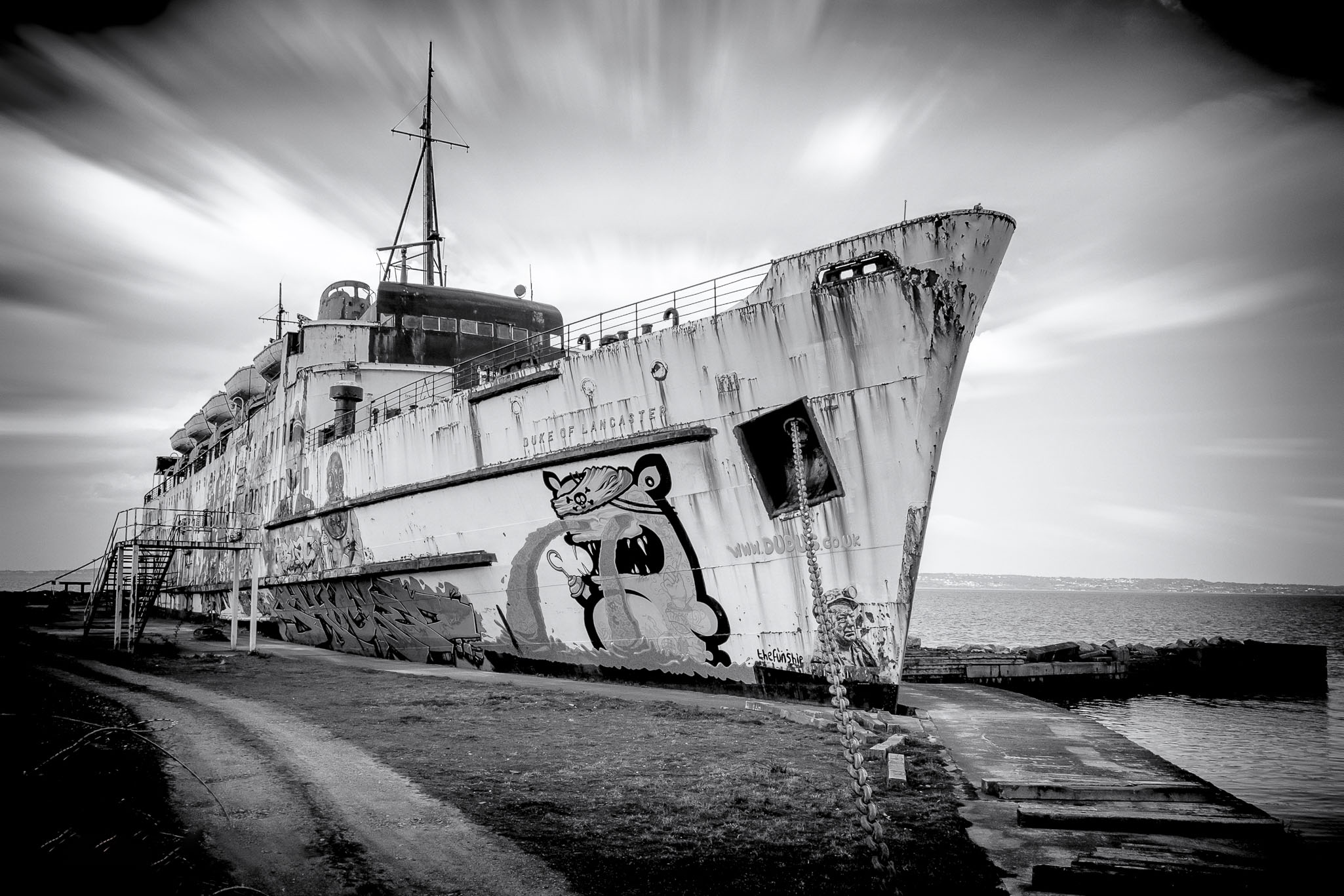
This is the TSS Duke of Lancaster, a rusting steel ghost stranded on the Welsh coast. Once a proud passenger ferry and cruise liner, she now stands frozen in time near Llanerch-y-Môr in Flintshire, her vast hull streaked with rust, salt, and defiant graffiti. The decks that once echoed with footsteps, laughter, and music now lie silent, broken only by the cries of gulls and the constant breath of the sea. Yet locals will tell you the ship is not truly empty. When the tide rolls in and the wind howls through her corroded frame, they say you can still hear footsteps pacing the upper deck, slow and deliberate, accompanied by the distant echo of lives that never quite left the water.
I photographed the TSS Duke of Lancaster on a grey, wind-torn Sunday afternoon, the kind of day where the sea feels restless, almost sentient. The ship rose from the shoreline like a rusted beast, half-buried, half-awake, its steel skin flaking and bleeding orange into the sand. Once a symbol of movement and escape, she now stands immobile at the edge of Wales, caught between land and sea. Gulls circled overhead in tight, agitated loops, their cries sharp and accusing, like restless spirits guarding something that should not be disturbed. Through my camera lens, the ship looked almost human, tired and wounded, bowed by time and full of secrets she refused to give up easily.
As I moved closer, the soundscape changed. The wind threaded itself through shattered windows and open doorways, producing a low, mournful whistle that rose and fell like breath. Each gust carried the smell of salt, rust, and damp metal, thick and clinging. Locals in nearby pubs had told me stories, always lowering their voices as they spoke, tales of footsteps heard long after dark, shadows glimpsed pacing the upper railings, and a voice that sometimes calls out from inside the sealed hull. Standing there with my camera in hand, staring into those darkened portholes, I felt an unmistakable sensation of being observed, as though something inside the ship was aware of my presence and waiting for me to look away first.
The Duke of Lancaster was not always a ghost. She once carried passengers between Ireland and England, her decks alive with movement, conversation, and the steady rhythm of travel. Later, she was reborn as a floating entertainment venue, a so-called “fun ship,” permanently moored and filled with bars, games, dancing, and artificial cheer. Lights burned late into the night, music spilled out over the water, and for a time, she felt alive again. Then it all ended abruptly. Rumours began to circulate, whispered and half-denied, of accidents and tragedy. A man falling from the upper deck under unclear circumstances. A woman reportedly seen standing by the handrail late at night, weeping softly before vanishing into the tide. No official explanations ever satisfied the stories. What remained was silence, broken only by the crash of waves and the slow creak of metal that has forgotten what it means to move.
I arrived just as the tide began to creep back in, the water steadily swallowing the sand around the hull. Each photograph felt heavy, as if the camera was capturing more than light, perhaps fragments of memory or emotion pressed into the air. The paintwork, now layered with eerie murals and aggressive graffiti, seemed to shift as mist rolled across the shore, giving the illusion that the ship itself was breathing. One image in particular, a crudely painted face stretched across the hull, caught my eye. Through the lens, it looked less like art and more like a mask, as if the ship had chosen a face and was staring directly back at me.
When I finally stepped away, the wind dropped suddenly and the air grew unnaturally still. From somewhere deep inside the vessel came the faint clang of metal, once, then again, slow and measured, like footsteps moving below deck. My instinct told me not to stay. I packed up quickly, but before turning my back for good, I raised the camera one last time. For a brief moment, blurred by sea spray and fading light, I thought I saw a figure standing by the railings, motionless, watching as I left the Duke of Lancaster to her silence.
Useful Information:
- 🌎 Location: TSS Duke of Lancaster, Llanerch-y-Môr, Flintshire, North Wales
- ℹ️ Details: A former British passenger ferry and cruise ship launched in 1955, now abandoned on the Dee Estuary and widely regarded as one of the UK’s most striking maritime relics
- ✨ Signature Feature: A vast rusting hull covered in graffiti and murals, famous for its eerie atmosphere, ghost stories, and reputation as a haunted coastal landmark
- 🏢 Central Landmark: Situated on the shoreline near the village of Llanerch-y-Môr, close to the River Dee estuary and the former Mostyn docks area
- 📍 Satnav: Llanerch-y-Môr, Flintshire
- 🧭 Coordinates: 53.30299104037512, -3.238863057659451
- 🅿️ Parking: Limited roadside parking available nearby along the A548; the ship itself is fenced off and not legally accessible
- 🌐 Useful Link: Wikipedia
Related Posts:
- Mi Amigo: Remembering the 1944 Sheffield Crash at Endcliffe Park
- The Chained Oak of Alton: Dark Folklore, Real History & the Legend Behind the Chains
- The Forgotten Spirits of Edinburgh Castle
- The Story of Greyfriars Bobby, Edinburgh’s Most Loyal Dog
- The Legend of Molly Leigh — The Burslem Witch
Related Tags:
Dark History Dark Tourism Disaster Sites Folklore True Crime Unsolved Mysteries