
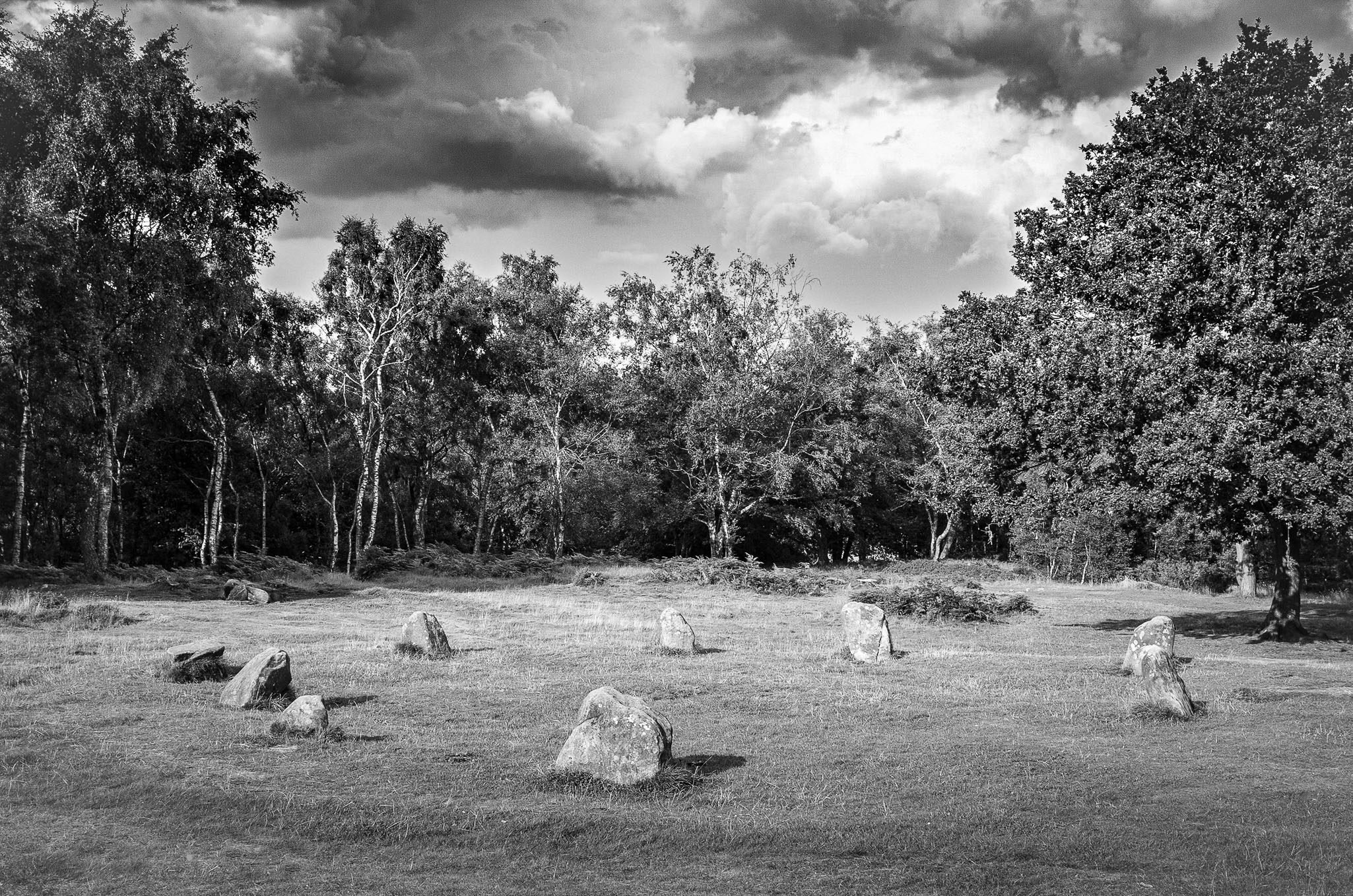
The Nine Ladies Stone Circle stands high on Stanton Moor in Derbyshire, exposed to wind, mist, and centuries of passing seasons. This prehistoric monument is formed from ten rough-hewn stones, nine set in a near-perfect circle and a tenth standing apart on the moorland slope. Known as the King Stone, or sometimes the Fiddler Stone, it watches from a distance, as if exiled from the others. Weathered and uneven, the stones feel less placed than grown from the earth itself, rooted deep in peat and memory.
Local folklore tells a cautionary tale. Nine women, defying the strict laws of the Sabbath, danced through holy time to the sound of a fiddle. For their disobedience, they were struck down and turned to stone, frozen mid-revelry for all eternity. The lone King Stone marks the fiddler who played for them, cursed alongside his dancers but condemned to stand apart, forever able to see the circle yet never rejoin it. The story lingers heavily on the moor, transforming the stones from mere monuments into figures locked in an ancient act of defiance and punishment.
Beyond legend, archaeology suggests the Nine Ladies was a ceremonial site, likely used during the Bronze Age. Such circles were often aligned with the rhythms of the natural world, tied to seasonal change, fertility, death, and renewal. The open landscape and elevated position would have made this a powerful gathering place, where firelight, shadow, and ritual could transform the moor into something otherworldly. Even stripped of myth, the site carries a weight that hints at long-forgotten rites and beliefs.
There is an undeniable atmosphere here. On quiet days the circle feels contemplative, almost reverent, but when fog rolls in or the wind sweeps across the heather, it can feel unsettling, as though the land itself remembers what happened. Time seems to thin within the ring, blurring past and present, leaving visitors with the sense that they are intruding on something unfinished.
That spiritual pull has never faded. Modern druids, pagans, and seekers still gather at the Nine Ladies to mark solstices, equinoxes, and seasonal festivals. Fires are lit, chants carried into the open sky, and offerings laid at the stones, echoing practices that may stretch back thousands of years. In these moments, the circle feels alive again, briefly reactivated by human presence and intention.
The Nine Ladies stand silent on Stanton Moor, but their story endures. Whether seen as dancers caught mid-step, relics of ancient ritual, or sentinels of a forgotten world, the stones continue to watch, waiting, while the moor breathes around them.
Useful Information:
- 🌎 Location: Stanton Moor, Peak District, Derbyshire, England
- ℹ️ Details: A Bronze Age stone circle dating to around 2000–1500 BC, made up of nine standing stones arranged in a ring, with a tenth outlying stone known as the King Stone or Fiddler Stone.
- ✨ Signature Feature: Strongly associated with folklore telling of nine women turned to stone for dancing on the Sabbath, with the nearby King Stone representing the fiddler.
- 🏢 Central Landmark: Stanton Moor, within the Peak District National Park, near the village of Stanton-in-Peak.
- 📍 Satnav: Stanton Moor Stone Circle
- 🧭 Coordinates: 53.16801112561079, -1.6288171505267761
- 🅿️ Parking: Free car park nearby
- 🌐 Official Link: English Heritage
Related Posts:
- Mi Amigo: Remembering the 1944 Sheffield Crash at Endcliffe Park
- The Chained Oak of Alton: Dark Folklore, Real History & the Legend Behind the Chains
- The Forgotten Spirits of Edinburgh Castle
- The Story of Greyfriars Bobby, Edinburgh’s Most Loyal Dog
- The Legend of Molly Leigh — The Burslem Witch
Related Tags:
Dark History Dark Tourism Disaster Sites Folklore True Crime Unsolved Mysteries